Don't Buy a GPS Tracker Until You Ask These 5 Questions

If you’re looking for a GPS tracker for your rental fleet, you know how overwhelming it can be. A quick online search bombards you with a hundred companies, all shouting about different features, price points, and promises.

No subscription vs. subscription. Cheap vs. expensive. Hardwired vs. plug-and-play. The list is endless.

So, how do you cut through the noise? How do you pick the right company so you don’t end up wasting money and time by switching later?

Here’s the truth: most people think a GPS tracker is just a dot on a map. But after a decade in this industry, I can tell you it’s so much more. I started from the ground up, and I’ve learned the hard way what truly matters. I want to share that with you now, so you can make a decision you won’t regret.

These five questions are tailored for the car rental industry. Your goal isn’t just to track a car; it’s to achieve the highest level of security for your assets. You need to sleep soundly, knowing your fleet is protected even when it’s out of your direct control.

A real GPS solution isn’t just for when things are good—it’s your lifeline for when things go wrong.

Let’s get started.

Question 1: Does the company use a top-tier network, or a budget reseller?

Why it matters: This is the difference between reliability and a dead spot when you need it most.

Let me break it down. There are two types of cellular providers:

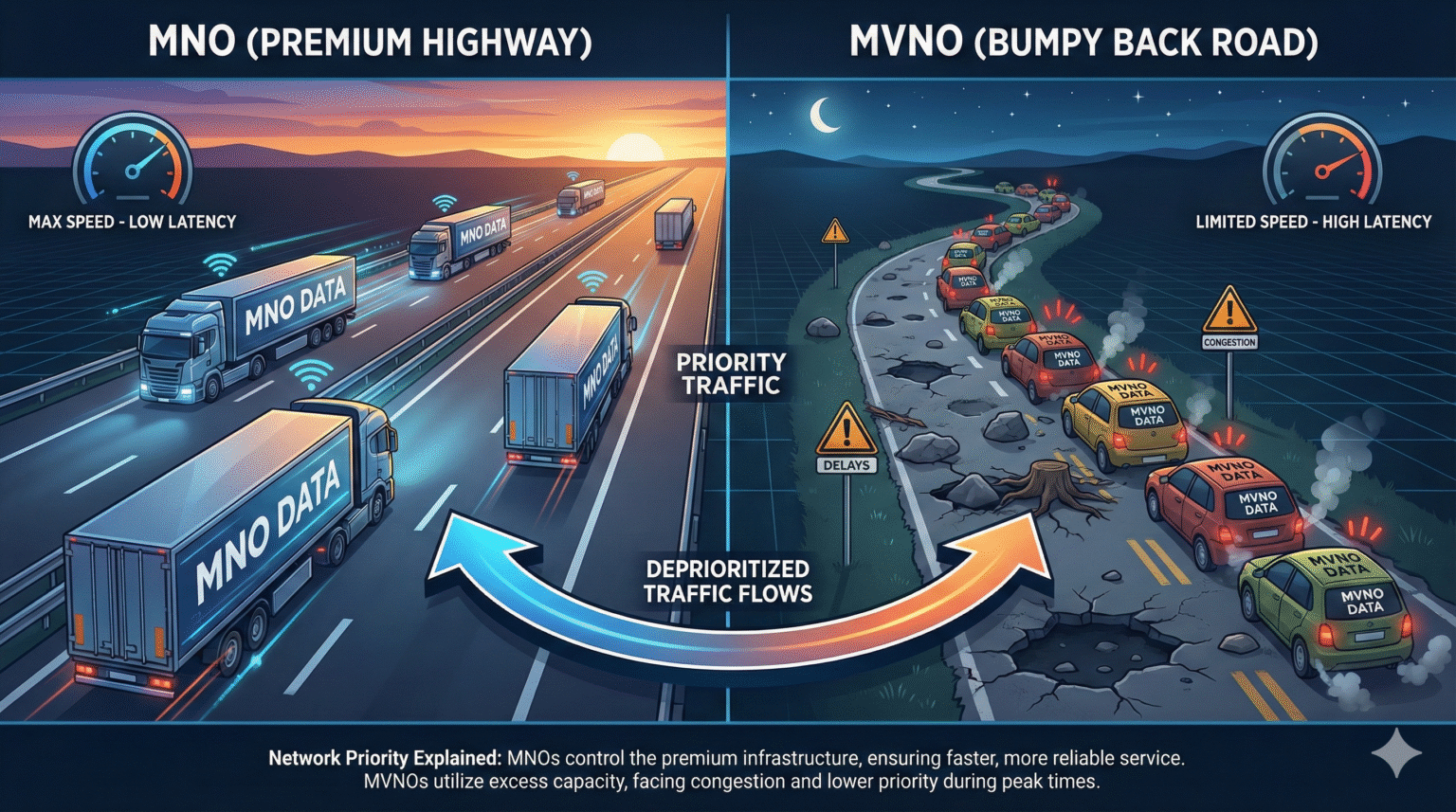
  • MNOs (Mobile Network Operators): These are the giants like AT&T, T-Mobile, and Verizon. They own the cell towers and the infrastructure.

  • MVNOs (Mobile Virtual Network Operators): These are resellers. They buy space in bulk from the MNOs and sell it to smaller companies.

Think of it like a highway system. An MNO’s own SIM cards always get to drive on the fast, open highway. MVNO SIMs are allowed on, too… until traffic gets heavy. The moment the highway gets crowded, the MNO prioritizes its own traffic and pushes the MVNOs to the bumpy, slow back roads.

The Bottom Line: A company using an MNO SIM (like directly from AT&T or Verizon) offers higher reliability because your data gets priority on the network. When every second counts, you don’t want your tracker’s signal stuck on a digital back road.

Question 2: Is the device officially certified for the network?

Why it matters: A SIM card is useless if the device itself can’t connect reliably.

This question is a natural follow-up to the first one. Here’s the secret: for a company to buy SIMs directly from an MNO, their tracking device must pass rigorous certification tests—like the PTCRB certification in the US.

This isn’t just a formality. It means the device’s cellular antenna has been tested to perform excellently across all the different frequencies used in the United States. Many companies import cheap devices from China with generic antennas. Sure, they might show you a dot on a map under perfect conditions. But we’re not interested in perfect conditions. We’re interested in the edge cases—the challenging situations where you really need your tracker to work. That’s where a certified device wins, every single time.

Question 3: Does the GPS tracker have a reliable internal battery?

Why it matters: Without a battery, you’re left in the dark the moment a thief unplugs your device.

In the car rental industry, a device without an internal battery should be an immediate “no” for anyone serious about security. Why? Because a power-cut alert should be the beginning of your recovery effort, not the end of your visibility.

Let me give you a real-world example from my ten years of experience:

  • Scenario A (No Battery): You get a “device unplugged” alert. The car keeps moving, but your screen is blank. You have no idea where it is. All you can do is panic.

  • Scenario B (With Battery): You get a “device unplugged” alert. The car keeps moving, but your tracker continues reporting its location for hours. You now know it’s being stolen and have a critical window to track it and alert the authorities.

That internal battery is what turns a moment of panic into a controlled, proactive recovery mission. Trust me, you don’t want the stress of the first scenario.

Question 4: Is the device compact, discreet, and self-contained?

Why it matters: A big, clunky tracker with external antennas is easy for a thief to find and disable.

Think about modern car dashboards. They’re compact, with very little spare room. Now, imagine trying to hide a tracking device behind one. A large device with blinking lights or bulky antennas will be found in minutes.

The ideal security tracker is small, black, and has no external parts. It should be able to slip seamlessly between wires and connectors, becoming virtually invisible. The harder it is to find, the longer it will continue reporting its location, giving you the upper hand. If a device is big and obvious, it’s a security flaw, not a feature.

Question 5: Does the company offer true 24/7 expert support?

Why it matters: When your car is being stolen, you need a partner, not just a portal.

Let’s be honest. If your car gets stolen on a Saturday night, looking at a map alone might not be enough. You need an expert on the phone who can read the data, understand what the tracker’s diagnostics are saying, and guide you through the crisis.

A true security partner has a support team that can help you interpret tracking history, event logs, and other data to understand what’s happening. If the company you’re considering isn’t available to support you during the nights and weekends when you’re most vulnerable, move on. Your asset’s security is too important for business-hours-only support.

Making the right choice in a GPS tracker isn’t about finding the longest list of features. It’s about finding a reliable, secure, and supportive partner that understands the unique pressures of the car rental business.

Ask these five questions. The answers will quickly separate the real experts from the marketing noise. They will lead you to a solution that doesn’t just give you a dot on a map, but gives you genuine peace of mind.

If you’re ready to see how our approach at Qarhami is built around these very principles, I invite you to Schedule a Demo. Let’s talk about how to build a security system you can truly count on.

Frequently Asked Questions

When a crisis like a theft is happening, stress is high and every second counts. Our support team doesn’t just look at the same map you see. We are trained to analyze diagnostic data, historical patterns, and event logs to give you a clearer picture. We can help you determine if it’s a genuine theft or a false alarm, guide you on the best course of action, and even assist with providing data to law enforcement. You’re not just getting a device; you’re getting an expert partner in your corner when you need it most.

Think of it like this: a certified device is a professionally tuned radio that gets a clear signal on every station, everywhere. An uncertified device is a cheap, dime-store radio that crackles and loses the signal when you drive under a bridge or into a rural area. When a thief drives your car into a parking garage or a remote location, that’s exactly when you need the signal to be strongest. An uncertified device is most likely to fail you at the worst possible moment.

It’s a common misconception. While the upfront cost might be slightly higher, you’re investing in reliability that saves you money in the long run. Consider the cost of a single stolen vehicle that couldn’t be recovered because of a lost signal. Or the revenue lost from downtime due to a faulty, uncertified device. With a premium tracker, you’re not just buying hardware; you’re buying insurance and peace of mind. The “cheap” option often becomes the most expensive mistake you can make.

AirTags are excellent for finding lost keys or a suitcase, but they are not a fleet security solution. They rely on a public network of Apple devices nearby to report a location. A thief with an iPhone will be notified that an “Unknown Accessory” is traveling with them, allowing them to find and disable it. Furthermore, they offer no real-time tracking, no remote immobilization, and no cellular backup. For professional car rental operations, they are a helpful supplement but a dangerous primary security layer.


© 2025 Qarhami. All Rights Reserved.