The Closed-Loop Maintenance SOP: Report, Resolve, Record, Remind
In the peer-to-peer car-sharing and vehicle rental industry, there is a silent, compounding margin killer that most operators fail to diagnose until it is too late: deferred maintenance.
When you operate a single vehicle, tracking maintenance is intuitive. You notice a slight alignment drift while driving it yourself, or you catch a low oil life percentage on the dashboard instrument cluster. You pull into a service center, fix the issue, and continue operating.
But as your asset count scales past three vehicles, your relationship with the physical fleet changes. You are no longer the primary driver. Your assets are subjected to varying driving behaviors, rough terrain, and rapid mileage accumulation under the control of third-party renters.
If you run your fleet on memory, messy WhatsApp groups, or a color-coded spreadsheet that requires manual updates, your maintenance tracking is fundamentally broken. You enter a high-stress state of operational firefighting—where you only deal with mechanical issues after they cause a mid-trip failure, strand a guest, or trigger a severe platform penalty that plummets your search visibility.
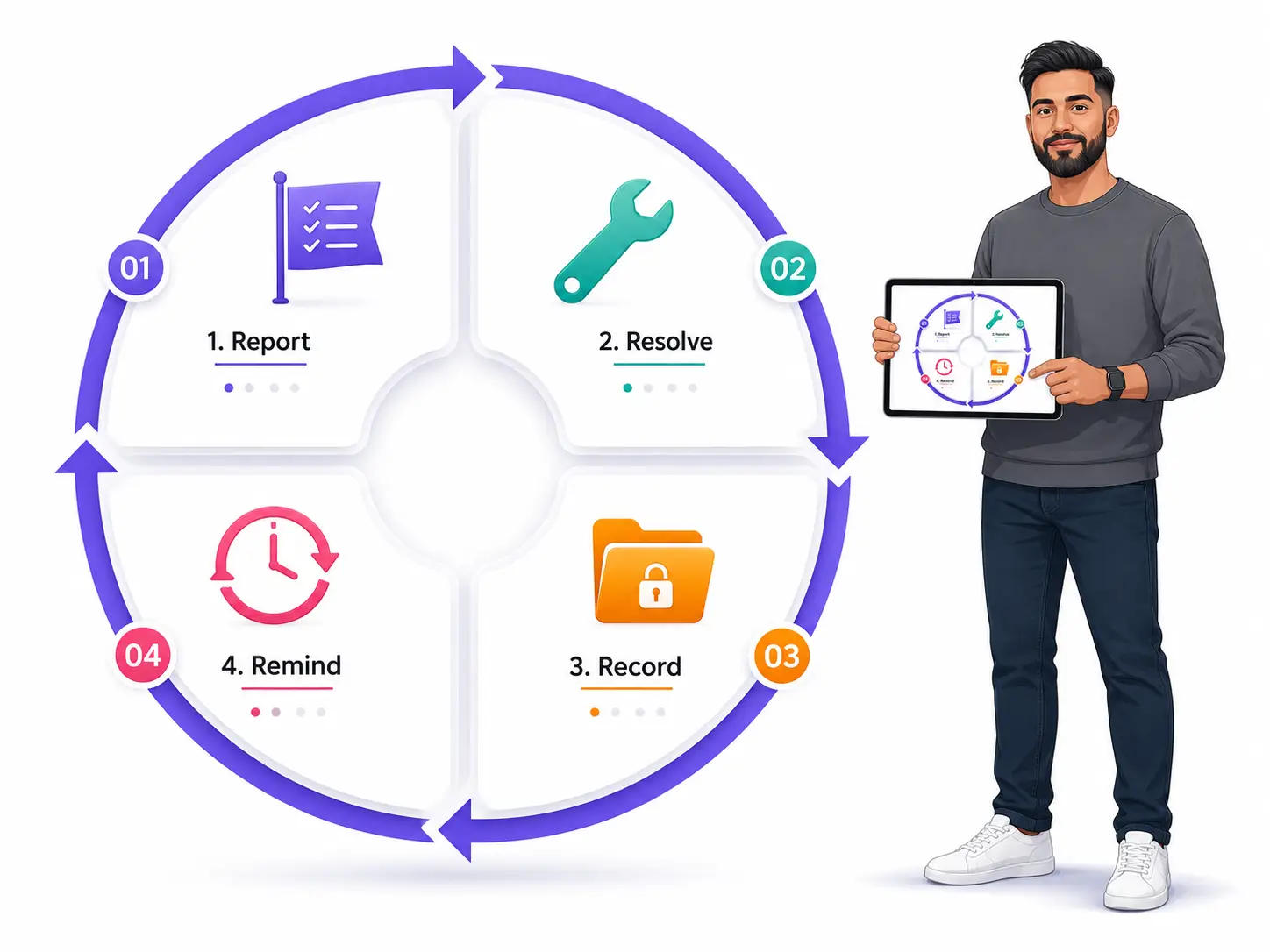
To build a reliable, high-yield rental business, you must eliminate the human variable. You must implement an unbreakable, self-sustaining protocol: The Closed-Loop Maintenance SOP.
The Anatomy of an Open Loop (Why Whiteboards Fail)
Before we dissect the solution, we must understand why typical host maintenance setups fail at scale. Most independent operations suffer from what logistics engineers call an open-loop workflow defect.
An open loop occurs when a mechanical issue is noticed but lacks a rigid, automated path to resolution. For example:
- A runner notices a chipped windshield during a vehicle turnaround.
- The runner sends a quick message in a team chat: “Car 2 has a tiny rock chip on the glass.”
- The group chat gets flooded with other operational messages, toll receipts, and parking confirmations.
- The message buried in the chat is forgotten. Three trips later, a guest hits a pothole, the tiny chip turns into a massive, unrepairable structural crack across the entire windshield, and the car must be taken offline immediately during a peak weekend demand window.
The open loop turned a $50 mobile glass repair into a $600 windshield replacement plus $400 in lost rental income. The goal of a professional fleet operator is to seal every loop the split second an anomaly is detected.
Step 1: Report (The Instant Capture Protocol)
The first step of the loop mandates that any mechanical deviation, aesthetic blemish, or diagnostic anomaly must be logged instantly into a centralized system of record. There is a strict zero-memory rule at this stage; if an issue is not documented immediately, it does not exist.
[Physical Anomaly Detected] ──> [Instant Digital Input] ──> [State Tag Isolation]
To execute this without adding friction to your field runners or detailing staff, the reporting layer must be completely frictionless. When a team member or a host performs a post-trip inspection, they should not write a narrative note. They must use a standardized digital interface to flag the specific vehicle component category:
- Drivetrain/Mechanical: Weird noises, transmission lag, engine checks.
- Consumables: Brake wear, tire tread depths, wiper degradation.
- Aesthetic/Safety: Paint chips, interior stains, glass cracks.
The moment an issue is reported, the vehicle’s status tag must undergo an automatic transition. The asset must drop from a “Trip-Ready” state into an isolated “Needs Review” or “Maintenance Hold” state. This structural barrier protects your portfolio from the catastrophic operational error of dispatching an unverified or unsafe vehicle to a new guest.
Step 2: Resolve (The Defect Triage Pipeline)
Once an issue is safely inside your system of record, it enters the Triage Pipeline. Resolving an issue does not mean rushing to a mechanic instantly for every minor blemish; it means assigning a priority tier based on safety, regulatory compliance, and asset preservation.
Operators categorize incoming issues into three distinct structural tiers:
Priority Tier | Criteria | Operational Action |
Tier 1: Critical Safety | Brake degradation, bald tires, active check-engine lights, steering anomalies. | Immediate Grounding: The vehicle is pulled from the fleet calendar instantly. Trips are reallocated. |
Tier 2: Routine Maintenance | Approaching oil change limits, minor fluid flushes, wiper replacements. | Scheduled Window: The issue is bundled into the vehicle’s next planned 3-hour turnaround block. |
Tier 3: Non-Critical Cosmetic | Minor seat stains, small bumper scrapes, interior trim issues. | Deferred Batching: Logged in the asset profile and scheduled during low-demand seasonal lulls. |
By separating your issues into clear, logical tiers, you optimize your fleet’s active utilization rate. You ensure that minor cosmetic issues do not cause unnecessary downtime, while simultaneously ensuring that no unsafe asset ever leaves your lot.
Step 3: Record (The Service History Engine)
When a repair is completed, most hosts commit a major financial mistake: they pay the mechanic’s invoice, throw the paper receipt into a glovebox or a physical drawer, and move on. They view repair completion as the end of the line.
Professional operators treat repairs as valuable financial data. The Record step requires that every parts invoice, labor charge, and service description be digitally bound to that specific vehicle’s permanent ledger.
The Financial and Legal Multiplier
Keeping precise, digital service records serves three critical business functions:
- Underwriting and Claims Compliance: If a guest experiences a catastrophic mechanical failure or an accident, your platform or commercial insurance underwriter will often audit your service records. If you cannot produce a timestamped, verifiable history proving the asset was meticulously maintained, your physical damage claim can be legally denied.
- True Yield Evaluation: Binding repair invoices to specific cars allows you to analyze your Net Margin Per Asset. If Car A makes $1,500 a month but requires $600 in ongoing repair maintenance, and Car B makes $1,200 a month but costs zero in upkeep, Car B is your true high-yield asset. Without granular record logging, your spreadsheet data is lying to you.
- Resale Capital Preservation: When it comes time to decommission a vehicle from your fleet, a fully auditable, digitized, single-source-of-truth service history significantly inflates the asset’s resale value to commercial buyers.
Step 4: Remind (The Perpetual System Trigger)
The final step of the loop is what makes it truly “closed.” A common error in manual fleet setups is treating maintenance as a collection of isolated events. You change the oil today, and you trust that you or your runner will remember to check it again in 5,000 miles.
A closed-loop system removes human trust entirely. The moment a service event is marked as resolved and recorded, the system must ingest that data to recalculate and deploy the next critical alert trigger.
[Service Completed & Recorded] ──> [System Recalculates Interval] ──> [Future Reminder Deployed]
To execute this level of predictive maintenance, your operational loop must rely on a combination of time parameters and real-time telemetry markers:
- Time-Driven Reminders: Used for calendar-locked safety parameters, such as annual state inspections, seasonal tire swaps, or biannual brake fluid moisture tests.
- Odometer Telemetry-Driven Reminders: Used for mileage-dependent mechanical consumables. Instead of manually checking physical odometers or hoping your team logs the miles during check-in, an advanced telemetry hardware module reads the engine mileage data automatically. When the vehicle crosses its defined operational threshold (e.g., exactly 4,750 miles driven since the last logged oil change), the loop self-corrects and automatically triggers a brand-new Step 1: Report task flag for your team.
The cycle resets itself perfectly, moving from vehicle data to automated task creation without a single human brain having to track the timeline.
Scaling to the Operating System Layer
The ultimate evolution of a rental operator is transitioning away from fragmented tools that create open-loop vulnerabilities. When your business is running on independent chats, scattered text disclosures, and manual record entries, your cognitive load scales linearly with every single car you buy.
To build a secure, hands-off operation that runs predictably whether you are awake or asleep, you must merge your physical fleet hardware data directly with your operational software rules.
A professional fleet platform does not just track where your vehicle is parked on a map. It serves as the intelligent connective tissue that monitors real-time battery voltage health, reads raw engine mileages automatically, houses your digitized parts invoices, and ensures your team adheres to standardized, checklist-driven turnaround SOPs.
By closing the loop on your maintenance, you stabilize your daily workflows, insulate your business from costly liability claims, and convert your fleet into a predictable, automated, high-yielding cash flow engine.
Stop guessing your asset health. Close the operational loop.
What exactly is an "Open Loop" in vehicle maintenance?
An open loop occurs when a vehicle issue or maintenance milestone is noticed or approached but lacks a structured, mandatory path to digital documentation and resolution. Open loops cause critical information to drop through the cracks of group chats or phone notes, leading to catastrophic compounding mechanical failures later on.
How does a Closed-Loop Maintenance SOP protect insurance claims?
Platform and commercial insurance providers require operators to maintain safe, roadworthy vehicles. In the event of a severe accident or mechanical dispute, underwriters routinely audit the vehicle’s service history. A digitized, timestamped record of parts invoices and preventative checkups serves as an absolute legal defense to ensure your claims are approved.
Why is tracking maintenance by manual spreadsheet entries unsustainable?
Spreadsheets are completely passive data silos that rely entirely on consistent, error-free human input. As a fleet expands to multiple vehicles, tracking dynamic odometer changes, calculating varied service intervals, and manually uploading invoices becomes a massive time bottleneck, leading to missed service dates and administrative burnout.
What is the difference between time-driven and telemetry-driven service reminders?
Time-driven reminders trigger based strictly on calendar dates (e.g., annual registration or seasonal tire changes). Telemetry-driven reminders utilize live OBD-II hardware modules to read exact vehicle odometer metrics in real time, automatically triggering task cards the exact moment a specific mileage wear threshold is breached.
Can minor cosmetic defects be safely deferred in a fleet operation?
Yes. High-level operators categorize maintenance into distinct triage tiers. While critical safety elements (brakes, tires) trigger an immediate vehicle grounding, non-critical cosmetic defects (minor upholstery stains, small exterior paint chips) are batched and deferred to scheduled downtime periods to maximize active booking utilization.