Asynchronous Fleet Management: Building Self-Healing Turnaround Workflows
In the lifecycle of a commercial rental fleet, the most dangerous and financially volatile period is the Turnover Window. The chaotic block of time between a vehicle returning from one guest and departing with the next.
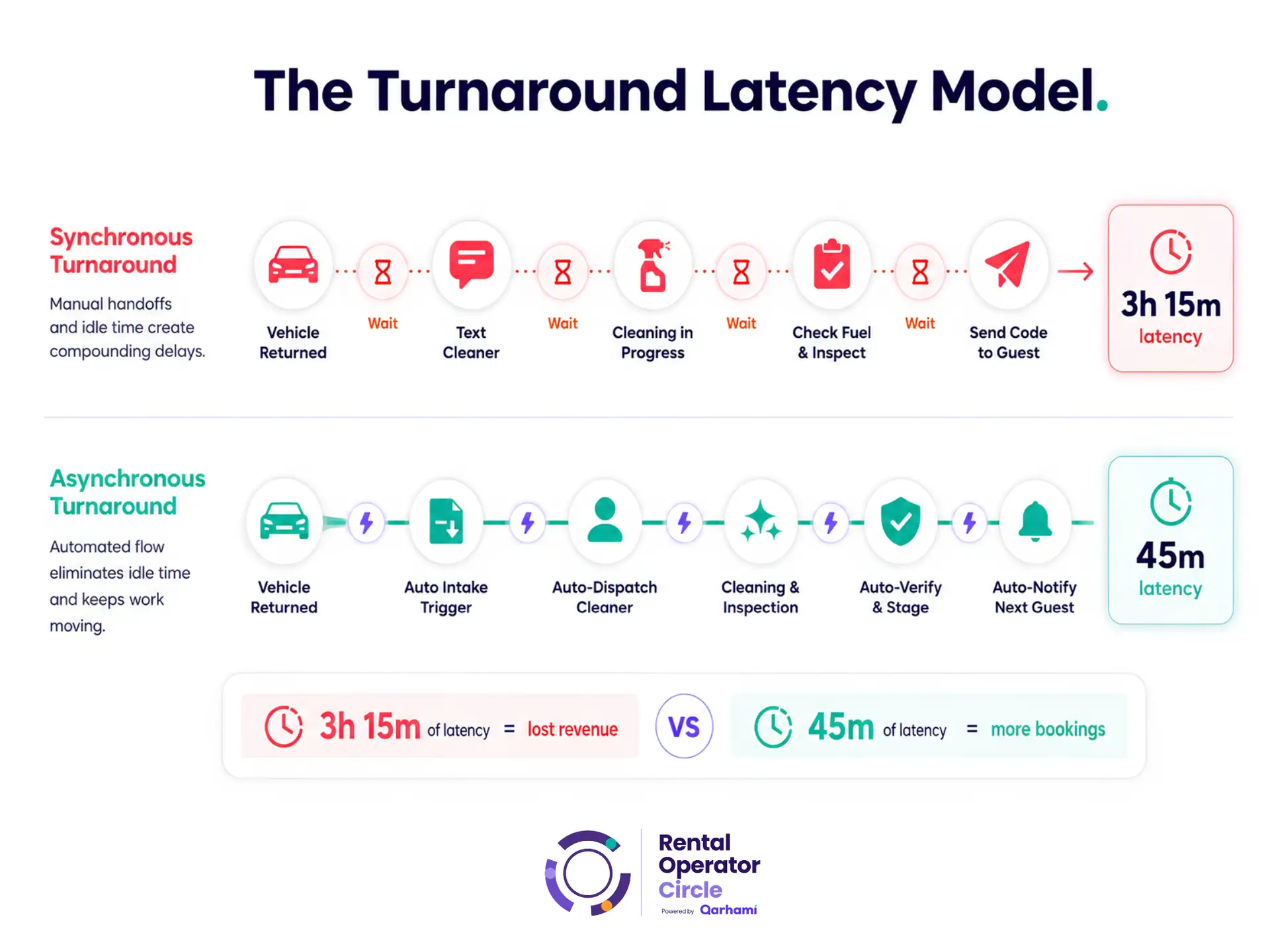
When an operator manages a small fleet, they naturally utilize Synchronous Management. The operator serves as the central processing unit for every physical action. When the car returns, the operator visually confirms it. The operator texts the cleaner. The cleaner texts back when finished. The operator reviews the photos, checks the fuel gauge, and manually sends the lockbox code to the next guest. Every single logistical step requires the operator’s active, synchronous presence.
If the operator is asleep, in a meeting, or on a flight, the entire business halts.
To break the 5-car, 10-car, or 50-car growth ceiling, you must entirely reconstruct your logistical architecture. You must transition to Asynchronous Fleet Management by designing Self-Healing Turnaround Workflows. In an asynchronous system, the operator does not trigger actions; the vehicle’s physical state triggers actions. The system identifies a bottleneck, routes the necessary labor, and heals the vehicle’s status back to “Trip-Ready” without a single human management prompt.
This is not a theory. This is the exact state-machine logic utilized by enterprise rental agencies, aviation logistics, and commercial trucking fleets.
The Synchronous Trap and The Latency Cost Model
Before engineering a self-healing workflow, you must quantify exactly how much your current manual process is costing you. In fleet logistics, this is known as Turnaround Latency—the delta between the absolute minimum time required to physically prep a car and the actual time it takes due to communication delays.
If a car requires 45 minutes of physical labor (cleaning, fueling, inspection) to turn around, but it takes 4 hours to complete because of texting delays, transit coordination, and manual verification, your Turnaround Latency is 3 hours and 15 minutes.
We model the financial devastation of this latency using the following equation:
Where:
= Number of vehicle turnovers per year (e.g., 60 per car).
= Hours of latency per turnover (e.g., 3.25 hours).
= Average daily rental rate (e.g., $85/day, which is roughly $3.54/hour of earning potential).
For a single vehicle, that 3.25 hours of latency per turn equates to almost 200 hours of artificial downtime per year, costing roughly $700 in lost revenue potential per asset. Multiply that across a 15-car fleet, and you are bleeding over $10,500 annually in pure gross margin—not because the cars are broken, but simply because your team is waiting for you to tell them what to do.
Synchronous management caps your fleet’s utilization velocity. Asynchronous management removes the cap entirely.
Defining State Machine Logic for Fleets
To build a self-healing workflow, you must deploy a Fleet Operating System that utilizes State Machine Logic.
In software engineering, a state machine is a mathematical model of computation. An entity can only be in exactly one of a finite number of states at any given time. It transitions from one state to another in response to specific, automated inputs.
Your rental vehicles are no longer just cars; they are digital nodes. To orchestrate them asynchronously, you must define their strict operational states. A vehicle cannot simply be “available.” It must exist in one of these rigid system tags:
- Trip-Active: The vehicle is currently in possession of a guest. Telemetry is logging mileage and voltage.
- Triage Queue (Post-Trip): The vehicle has breached the home geofence. The trip is over, but the asset is unverified.
- Needs Detail: The vehicle has passed mechanical inspection but requires interior sanitization.
- Maintenance Hold: The vehicle has flagged a critical diagnostic code or physical damage. It is hard-locked from future bookings.
- Trip-Ready: The vehicle is fully staged, fueled, clean, and digitally authorized for the next guest.
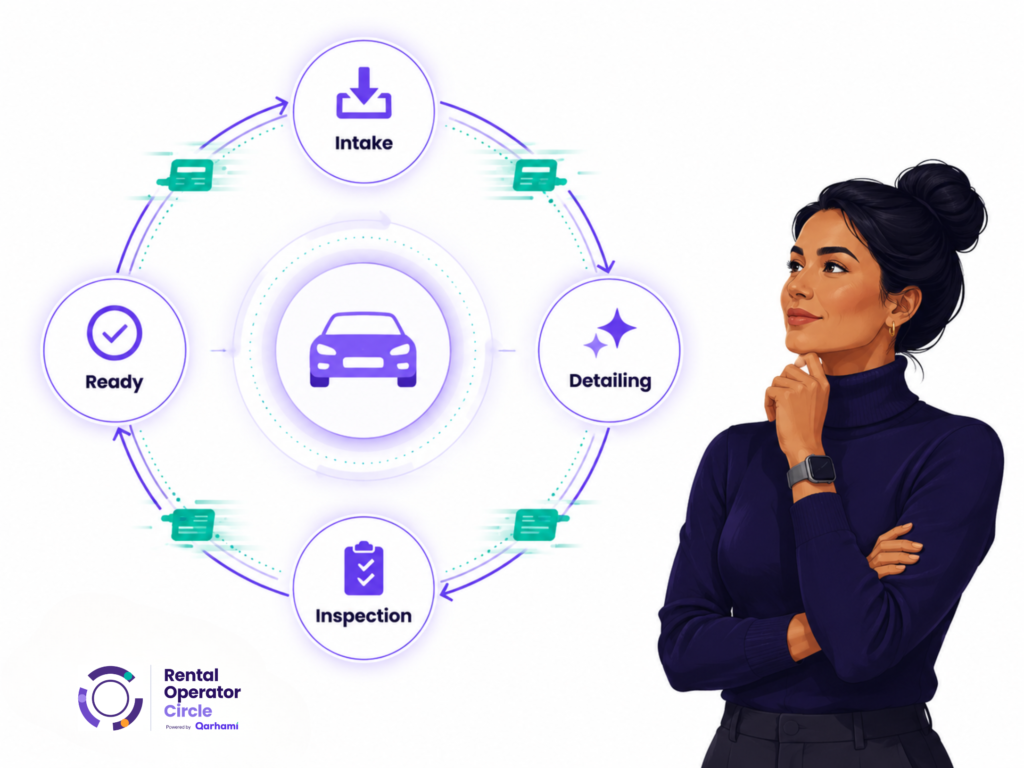
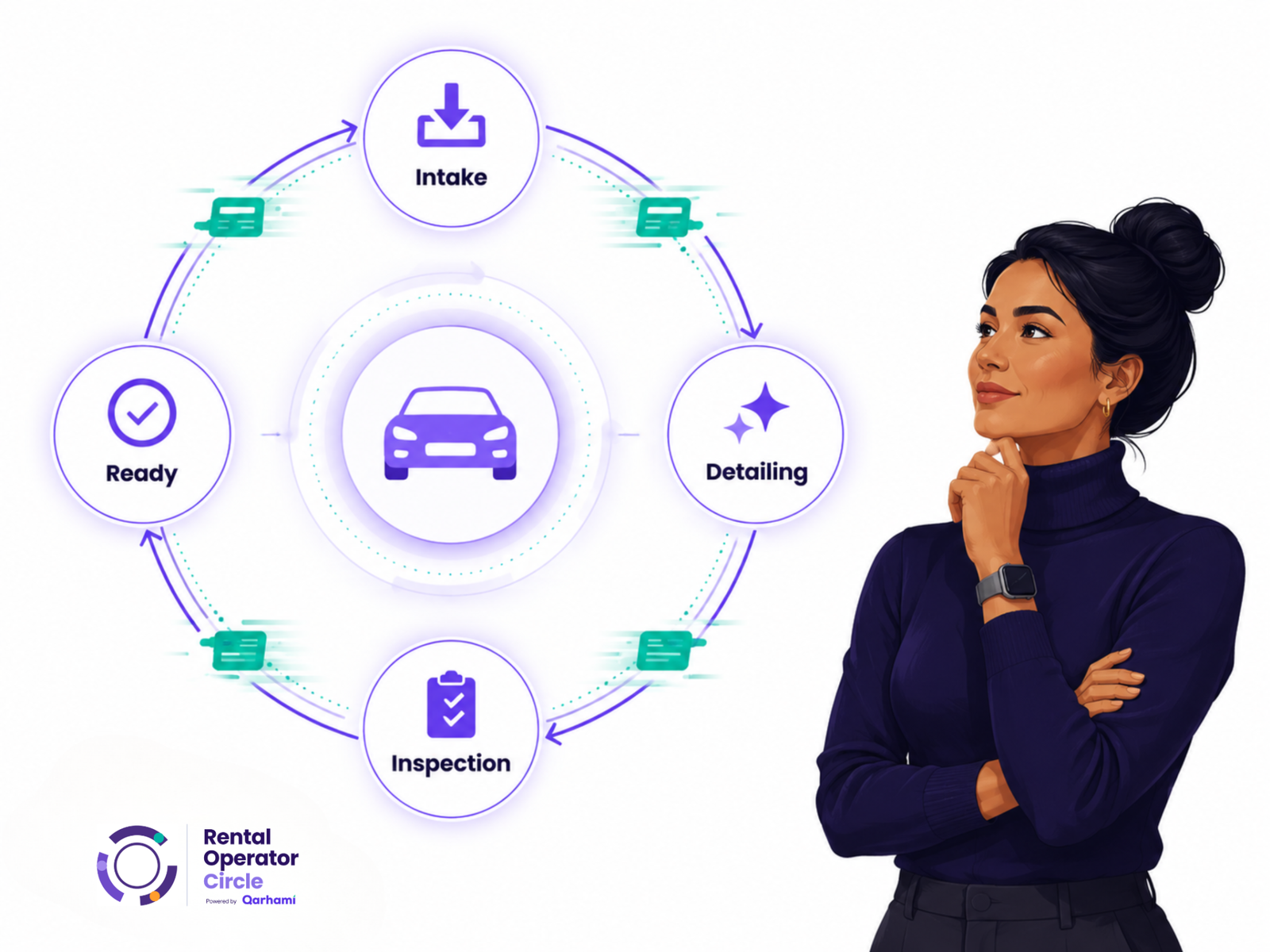
A self-healing workflow is the automated protocol that forces a vehicle trapped in the “Triage Queue” back into the “Trip-Ready” state without you, the operator, acting as the dispatcher.
Architecting the Self-Healing Turnaround Workflow
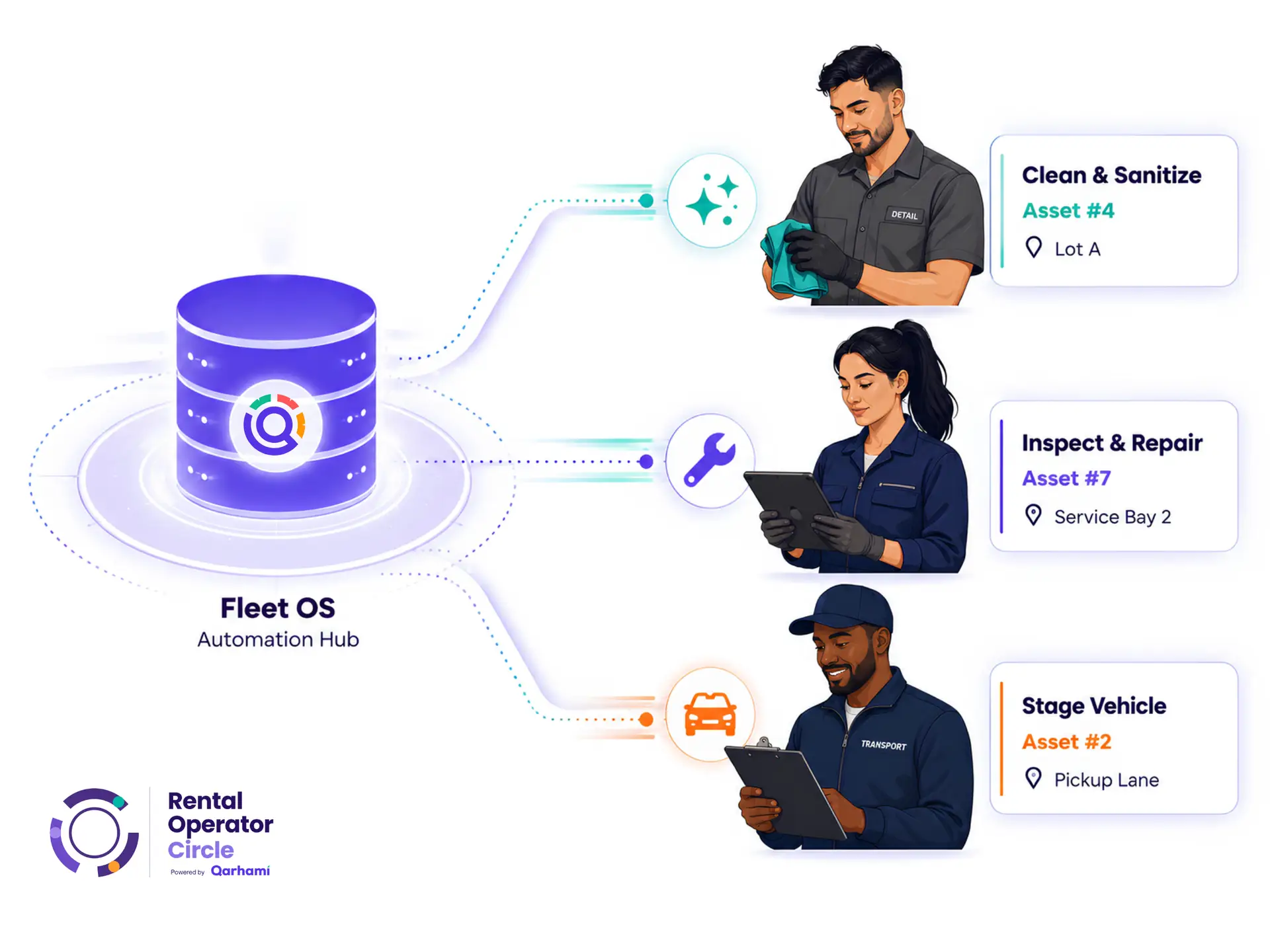
A true asynchronous workflow requires hardware, software, and human labor to interact in a strict, trigger-based sequence. Here is the exact blueprint for a self-healing turnaround.
Phase 1: The Automated Intake Trigger
In a manual fleet, the host waits for the guest to text, “I left the keys in the visor.” This is a synchronous failure point. Guests forget to text, or they text the wrong number.
- The Asynchronous Trigger: Your Fleet OS relies on hardwired OBD-II telemetry. The exact second the vehicle breaches your home lot geofence and the engine is cut off, the OS fires a webhook.
- The Action: The system automatically shifts the vehicle state from Trip-Active to Triage Queue. The OS immediately pulls the ending odometer reading to log mileage overages and reads the exact fuel level percentage. It automatically calculates if the guest owes a reimbursement invoice. You have performed zero labor.
Pillar 2: Algorithmic Labor Routing
Now that the vehicle is in the Triage Queue, it must be processed. In a manual fleet, the host calls the detailing runner.
- The Asynchronous Trigger: Because the vehicle entered the Triage Queue state, the OS automatically pushes a notification to your field runner’s mobile app: “Asset #4 requires intake at Lot A.”
- The Action: The runner arrives at the vehicle. They do not need a physical key; their employee access profile grants them a temporary Bluetooth unlock token. They complete a digital 25-point photographic inspection. If the runner marks the vehicle as clean and undamaged, the system auto-shifts the state to Trip-Ready.
Phase 3: Automated Exception Handling (The "Healing" Process)
This is where the system earns the title “Self-Healing.” What happens if the runner finds a deep scratch on the bumper or a check-engine light?
- The Asynchronous Trigger: The runner logs the defect in the app.
- The Action: The system instantly shifts the vehicle state to Maintenance Hold. It automatically scans your calendar API. If there is a booking overlap in the next 24 hours, the system flags a “Collision Alert” to your dashboard. Simultaneously, it generates a repair task card and routes it to your mechanical team.
- The Resolution: The vehicle sits in Maintenance Hold until the mechanic digitally signs off on the repair. The moment the repair is logged, the system heals the vehicle’s state, shifting it back to Trip-Ready and re-opening the calendar. The operator managed the exception, but the system managed the workflow.
Real-World Triage Scenarios
To fully grasp the power of asynchronous logistics, consider how the system handles high-stress scenarios that would traditionally cause a manual operator to panic.
Scenario A: The Late Night Battery Drain
The Problem: A guest leaves an interior dome light on at 1:00 AM while parked at an airport hotel. The operator is asleep. The next morning, the guest misses their flight because the car is dead.
The Asynchronous Solution: The Fleet OS telemetry detects a sustained voltage drop crossing the 11.8V threshold at 2:00 AM. The state-machine logic triggers a low-voltage alert. An automated SMS is pushed to the guest with instructions to turn off the light. If the voltage hits critical failure, a task is automatically generated for your morning runner to arrive with a jump box. The crisis is mitigated before the operator even pours their morning coffee.
Scenario B: The Back-to-Back Turnover Collision
The Problem: Car #1 is scheduled to be returned at 12:00 PM. A new guest is scheduled to pick it up at 1:30 PM. The first guest is stuck in traffic and returns the car at 1:15 PM, leaving 15 minutes for a 45-minute cleaning SOP.
The Asynchronous Solution: The OS recognizes the geofence breach at 1:15 PM. The system calculates that the Turnaround Latency requirement exceeds the available booking buffer. The OS immediately sends an automated SMS to the inbound guest: “Your vehicle is currently undergoing its final safety inspection and will be ready at exactly 2:00 PM.” The system buys the runner 45 minutes of buffer time automatically, protecting the asset’s cleanliness and the company’s or your reputation as a professional Host.
The Executive Decoupling
The ultimate goal of building a commercial rental fleet is to decouple your personal labor from top-line revenue growth.
If your fleet relies on synchronous management, every car you acquire is a liability to your personal freedom. You are buying yourself a highly stressful, decentralized dispatching job. You will eventually hit a ceiling where you physically cannot send texts, track lockbox codes, and coordinate cleaners fast enough.
By deploying an Operating System that relies on state-machine logic and asynchronous workflows, you remove yourself from the center of the operational wheel. You become the architect of the system, rather than a cog inside of it.
You do not manage cars. You manage the parameters of the system, and the system manages the cars. Stop acting as a dispatcher, deploy your self-healing workflows, and reclaim your operational scale.
Frequently Asked Questions
What does Asynchronous Fleet Management mean?
Asynchronous fleet management is a logistical model where operational tasks (cleaning, maintenance, handovers) are triggered automatically by the vehicle’s physical state or telemetry data, rather than requiring the host to manually coordinate and communicate each step in real-time.
What is Turnaround Latency?
Turnaround Latency is the wasted time between a rental car returning and being staged for the next trip, caused by communication delays, manual verification, and inefficient dispatching. High latency reduces a vehicle’s utilization rate and costs operators thousands in lost gross margin.
How does "State Machine Logic" apply to rental cars?
State machine logic treats a rental vehicle as a digital node that can only exist in one strict operational state at a time (e.g., Trip-Active, Triage Queue, Needs Detail, Trip-Ready). The vehicle transitions automatically between these states based on systemic triggers, ensuring an asset is never double-booked or dispatched while unsafe.
What is an automated intake trigger?
It is a telemetry-based workflow where hardwired OBD-II hardware detects when a vehicle crosses the home lot geofence and the engine is turned off. This automatically updates the car’s state to “returned,” logs the exact fuel and mileage, and pages the cleaning team without the operator doing anything.
How do self-healing workflows manage vehicle damage?
If a field runner logs damage in the system during a post-trip inspection, the self-healing workflow instantly shifts the vehicle to a “Maintenance Hold,” blocks the booking calendar, and routes a repair task to a mechanic. Once the mechanic digital signs off on the repair, the system “heals” the vehicle state back to “Trip-Ready.”