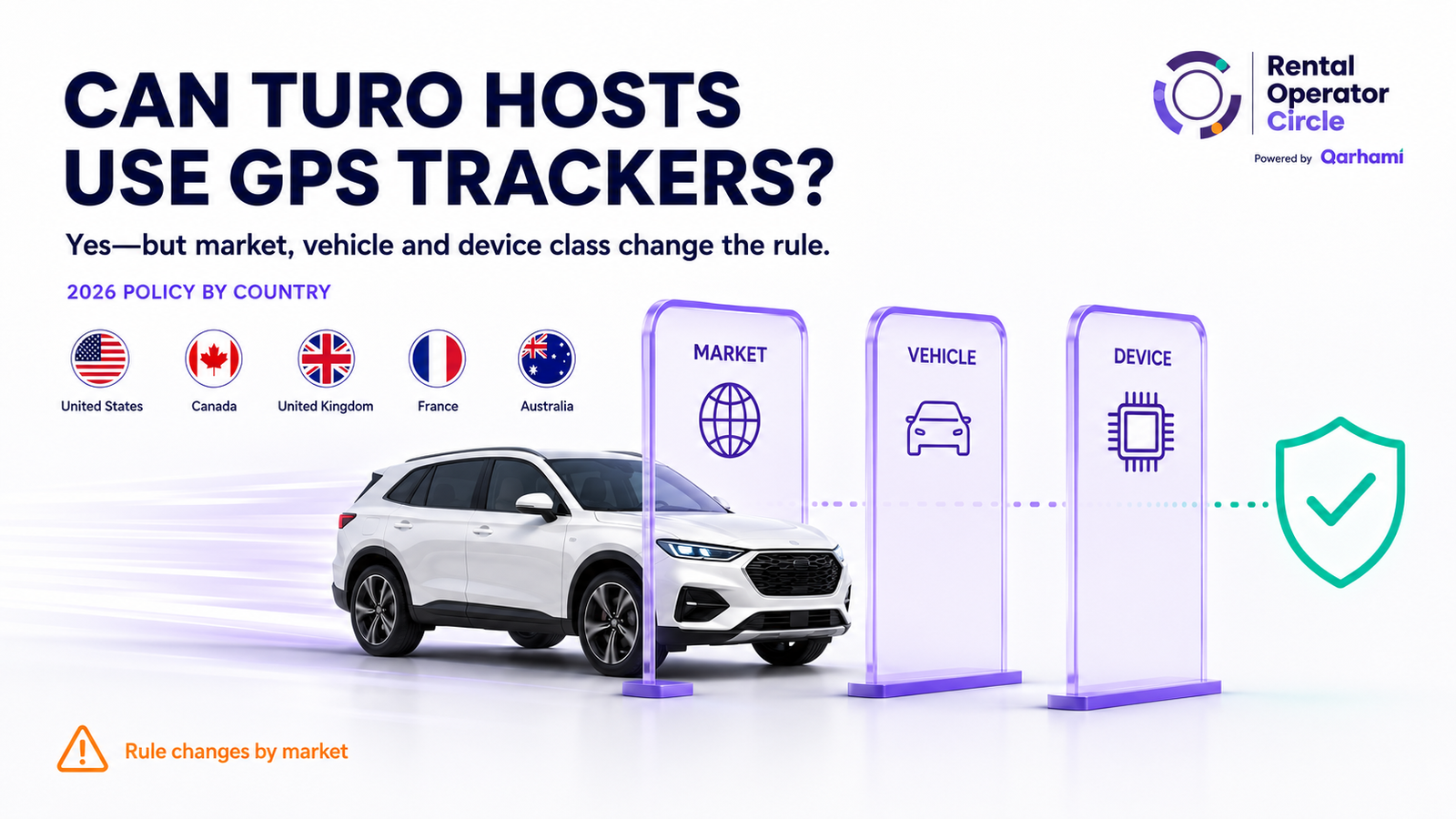
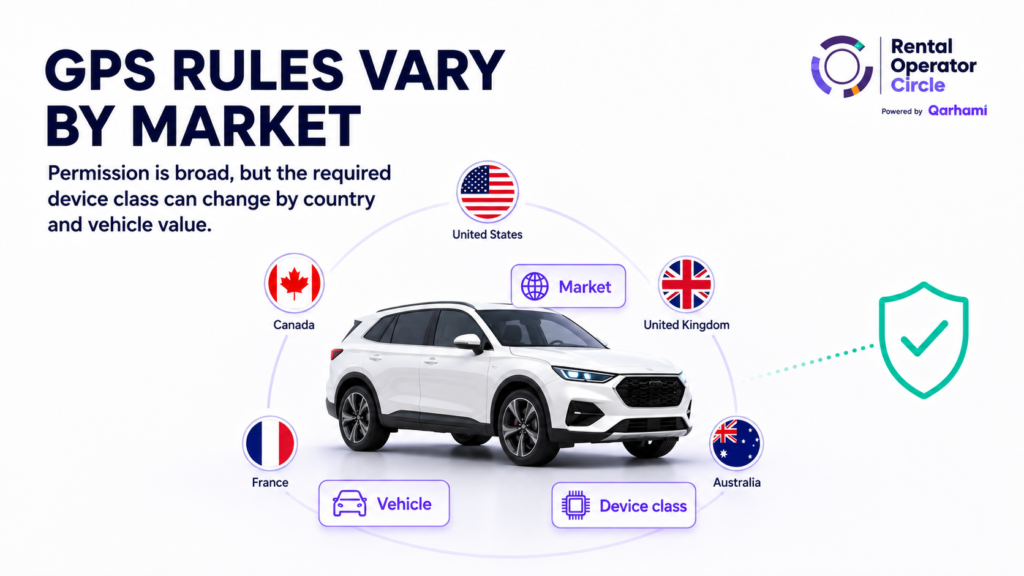
Yes. Turo permits hosts to use GPS, aftermarket trackers, OEM connected-car systems, cameras and telematics to protect vehicles. But permission is not approval of every device. AirTags are prohibited, interior cameras and audio need explicit written consent in Turo messaging, and the US, Canada, UK, France and Australia each apply different high-value-vehicle rules.
A tracker can be allowed by Turo in principle and still be the wrong device for a specific car, country, insurance policy, finance agreement or privacy regime.
This is a platform-policy guide reviewed August 2, 2026 — not legal advice. Always check the live Turo page, applicable law, your insurer’s requirements and any lease or finance restriction before relying on a device or its data.
An Australian host buys a well-reviewed OBD tracker. Good brand, fast updates, strong app, internal battery. Plugs it into an SUV worth about A$80,000 and lists the car.
Nothing about that device is bad. It would be a sensible choice on a $20,000 sedan.
But Turo requires Australian hosts with a vehicle at A$75,000 or more to maintain an activated GPS tracker that is not connected through the OBD-II port. It’s a rule about form factor, not quality. The best OBD tracker on the market still fails it, because the requirement is about where the device connects.
The host finds out after a claim. Noncompliance can lead Turo to withhold up to 20% of covered damages above the earnings-plan damage responsibility.
That is the whole subject of this guide: the gap between is this a good tracker and is this the required class of tracker for this car in this market.
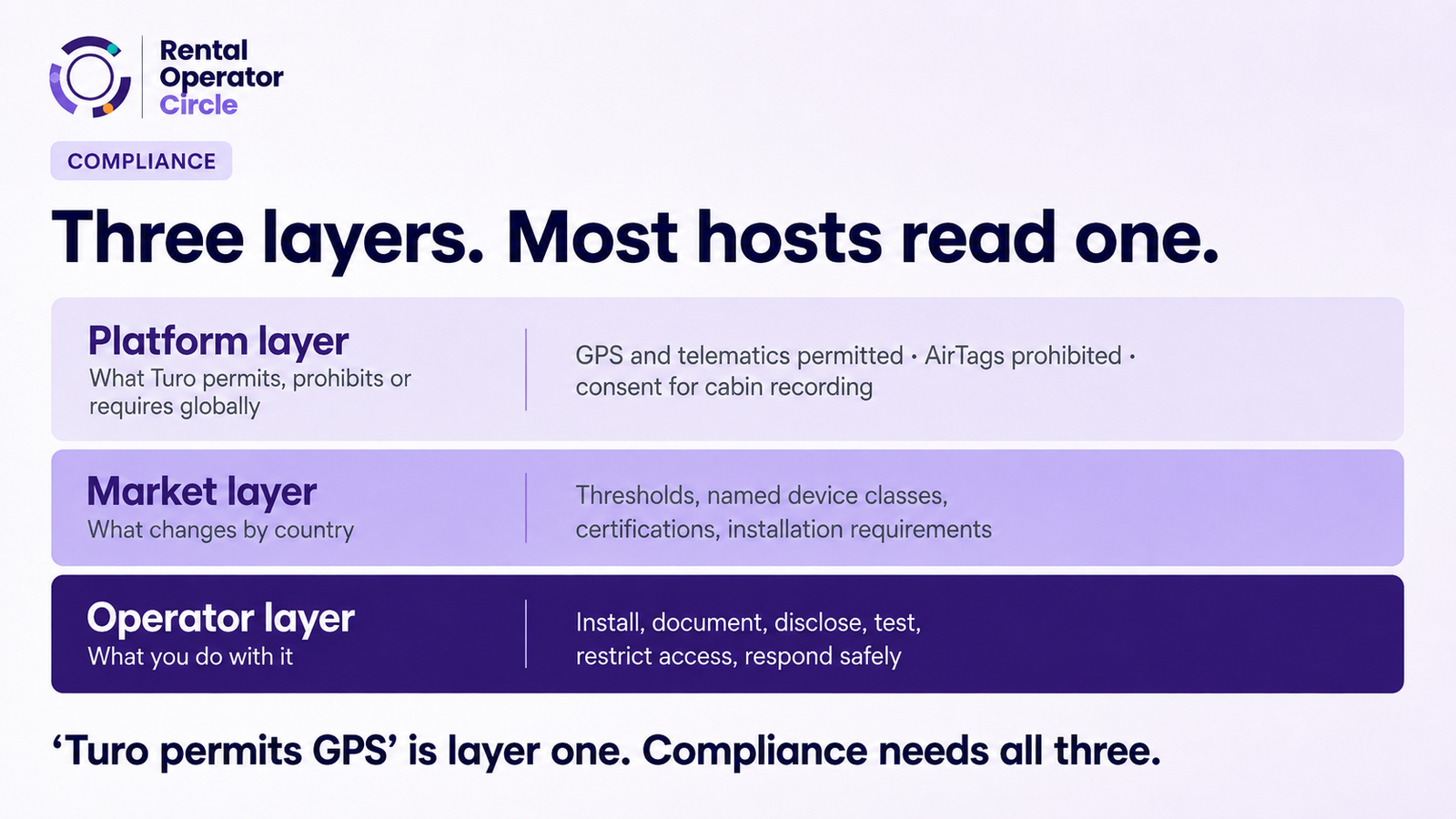
“Turo permits GPS” is the first layer. Compliance needs all three.
The platform layer. What Turo permits, prohibits or requires globally.
The market layer. What changes in the US, Canada, UK, France or Australia — thresholds, device classes, certifications, installation requirements.
The operator layer. How you install it, document it, disclose it, test it, restrict access to it, and respond when it fires.
Most compliance mistakes happen because someone read layer one and stopped. “Turo permits GPS” does not mean any tracker is compliant everywhere, and it does not create a category called a Turo-approved tracker.
What is prohibited, and what needs consent
Classify the hardware before you decide what disclosure, consent, installation evidence or country rule applies.
Permitted categories: GPS units, aftermarket vehicle trackers, OEM devices, cameras and telematics. Permitted in general — which is not the same as satisfying a mandatory tracker rule.
Prohibited: AirTags as active vehicle trackers. Turo’s policy cites poor guest experience and unreliability as GPS trackers, with continued use risking penalties up to account suspension or removal. Removing the branding or switching to another consumer mesh tag doesn’t help — the UK active-tracker policy expressly rejects consumer-grade Bluetooth and mesh-network tags for vehicles under its requirement.
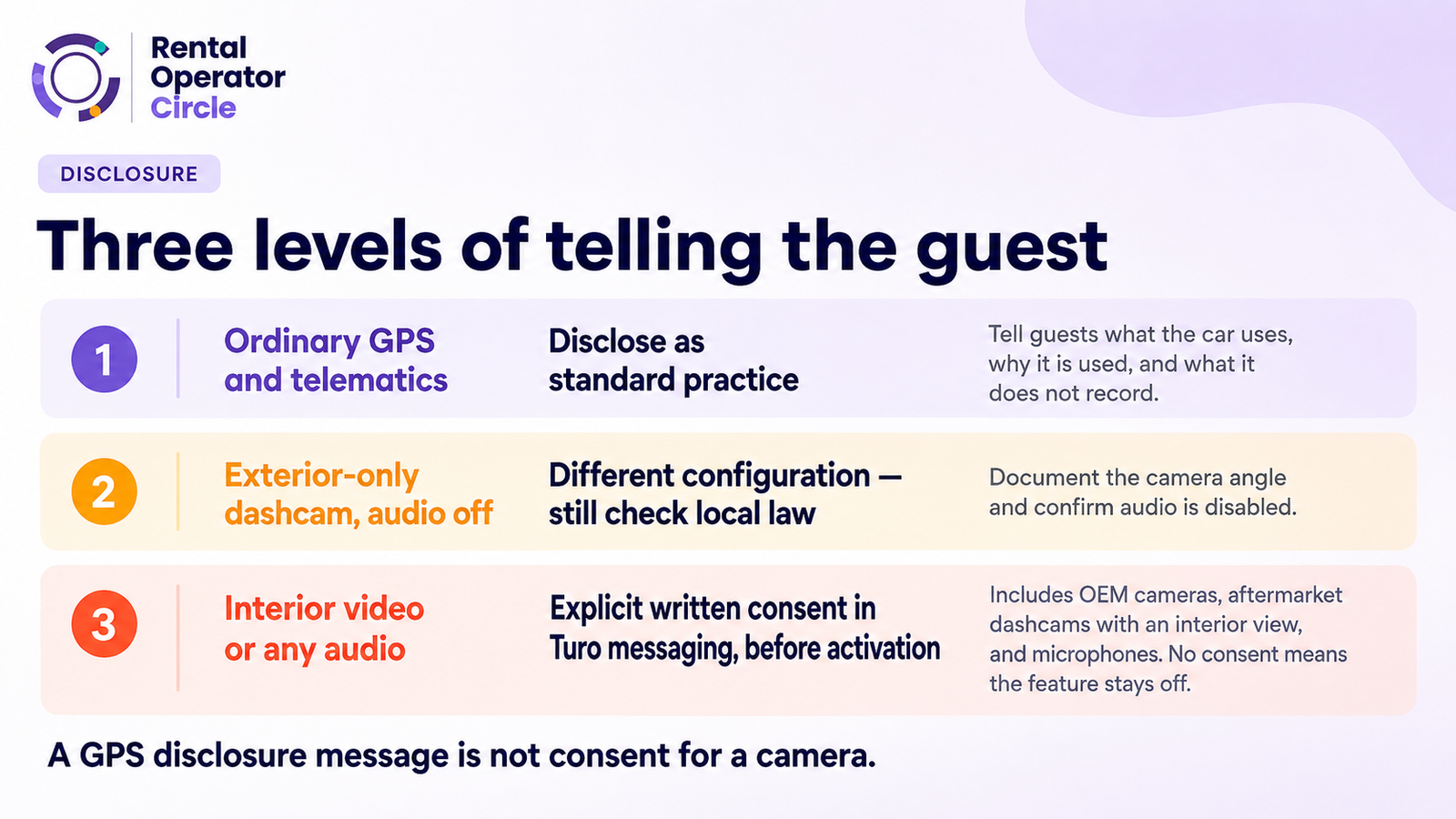
Consent required: anything recording the cabin or capturing audio. Every host, everywhere, must disclose the device and obtain explicit written consent in Turo messaging before activating it. That covers OEM-installed cameras, aftermarket dashcams with an interior view, and microphones. If the guest doesn’t consent, the feature stays off for that trip. Turo says accounts may be reviewed and hosts removed for using these without consent.
An exterior-only dashcam with audio disabled is a different configuration — but Turo’s permission doesn’t override local recording law. Document the camera angle, confirm audio is off, and check the law where the car operates.
Restricted in the UK: who can unlock the car. Turo does not permit a listed UK vehicle to have a device that lets an unauthorised party unlock it during a trip or obtain trip data. The permitted parties are the host, guest, Turo and Turo’s trusted partners, with exemptions for certain OEM- or insurer-required devices. Review who can reach vendor dashboards, support tools, location history and unlock commands — not just who knows the host password.
Keep the OEM subscription active; supply location data on formal request
Canada (most)
$105,000+
Activated OEM, TAG or KYCS
Keep proof and active status
Ontario, from Aug 4 2026
$60,000+; Teslas excluded
Activated TAG or KYCS, professionally installed by a third party
Keep the receipt and install proof; complete Turo listing approval
United Kingdom
£25,000–£49,999 / £50,000+
Sleeper tracker / Thatcham-approved S5 or S7
Keep subscription and professional install evidence; review data access
France
€25,000+, or under 10 years (see below)
Activated external tracker
Follow the stricter live rule; preserve proof
Australia
A$75,000+
Activated GPS tracker not via OBD-II
Use a qualifying non-OBD device; cooperate in open investigations
Ontario is a deadline, not a rule change to read later. Until 4 August 2026 Ontario follows the $105,000 threshold. From that date, vehicles at $60,000 or more need an activated TAG or KYCS tracker, professionally installed by a third party, with the receipt and installation proof retained; a support agent requests documents and approves the listing after the car is listed. A generic GPS device does not replace a named TAG, KYCS or OEM requirement. For the stated Canadian rules, failing to maintain the required active tracker may mean Turo withholds up to $30,000 of covered damages in a theft. If you have Ontario inventory, the vehicle-value audit and installation evidence belong before the effective date.
The UK is where access architecture matters most. Vehicles from £25,000 to £49,999 need at least an activated sleeper tracker — a subscription-based stolen-vehicle recovery asset with independent cellular and satellite positioning. If hardwired, Turo says it must be an aftermarket installation, not OEM, factory-fitted, OBD or plug-in. At £50,000 or more you need an activated aftermarket Thatcham-approved S5 or S7 tracker, with written confirmation and proof of professional third-party installation, and a current subscription. A tracker can be technically excellent and still leave you noncompliant because too many accounts can reach it.
France currently has two conflicting pages. Turo’s general tracking page says French hosts need an active tracker for vehicles worth €25,000 or more or less than six years old. Turo’s dedicated France tracker page says €25,000 or more and all vehicles under 10 years old need an activated external tracker — even when the car already has an OEM tracker.
That difference is material. Until Turo aligns the pages or confirms in writing, the defensible choice is the stricter dedicated rule: treat vehicles under 10 years old as needing the external tracker. The dedicated page also specifies autonomous GPS/LTE-M/LBS communication, at least daily proof-of-life positioning, and CE certification, plus reporting timelines for theft or late return.
Flag the conflict in your compliance register, save dated copies of both pages, and ask Turo support for written clarification. Do not quietly pick the easier threshold because it’s cheaper.
Turo’s consent rule is explicit for interior cameras and audio: disclose and obtain explicit written consent in Turo messaging before activation. For ordinary GPS, don’t invent a global “no disclosure needed” rule — platform policy, privacy law, contracts and local requirements are separate checks.
Ordinary GPS and cabin recording sit at completely different consent levels.
The safest standard is transparent, narrow and consistent. Tell guests what the vehicle uses, why, what it does not record, and how data may be used. Don’t frame routine monitoring as covert surveillance, and never use location data to harass or confront a guest.
A GPS disclosure you can reuse:
This vehicle uses GPS and vehicle telematics for theft prevention, asset recovery, trip administration and vehicle-health monitoring. The system does not record cabin audio or interior video. Device data is handled under applicable law and Turo policy. Please message us with any question about the vehicle’s technology.
If the car has an interior camera or any audio-capable device, that message is not enough. Ask a direct question in Turo messaging, wait for explicit written consent, preserve the response, and keep the feature off if the guest declines.
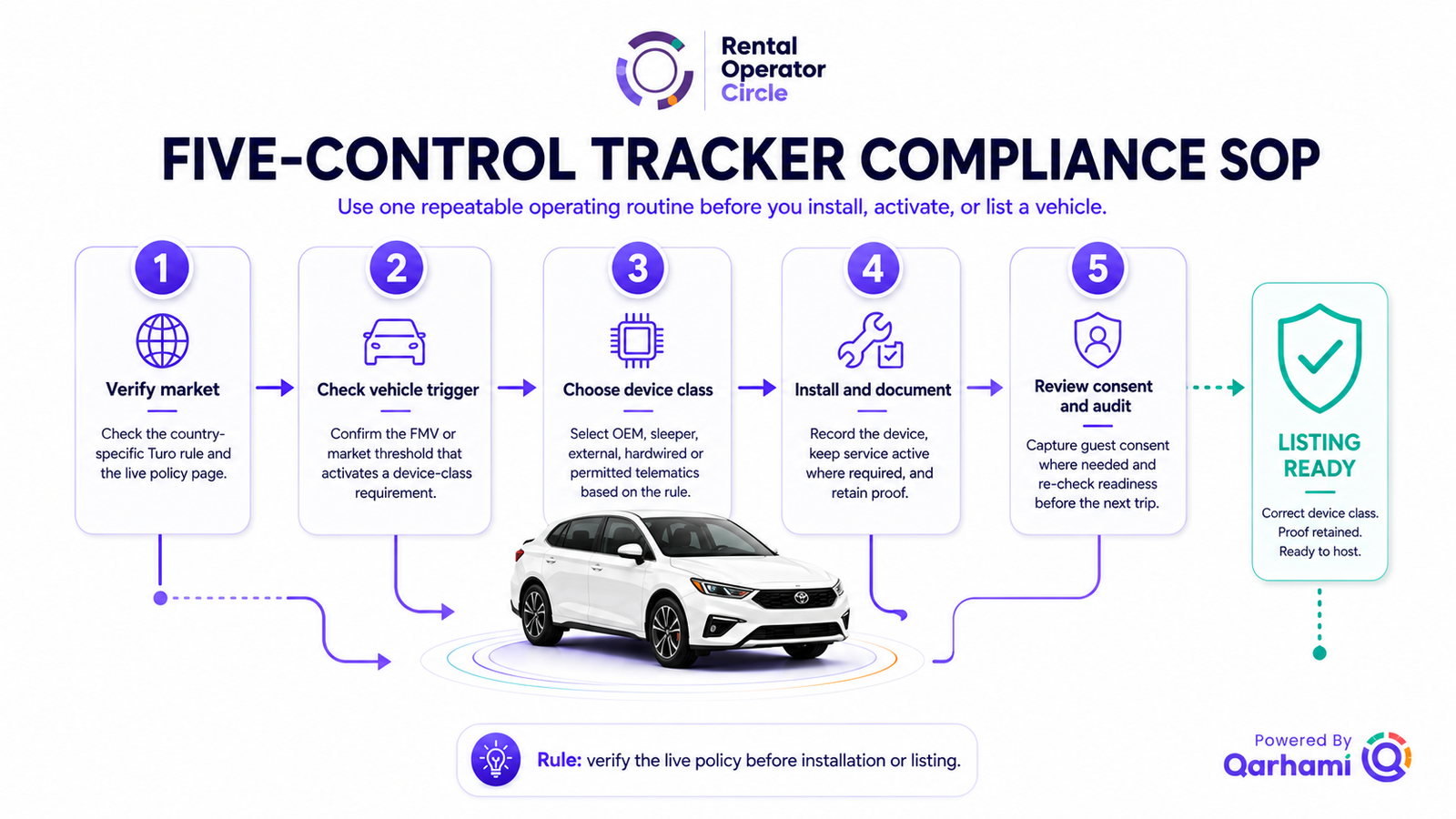
Record the vehicle’s listing country,
province or state where relevant, fair market value, age, and any high-value
designation. Open the live Turo host policy and the linked country policy.
Record the review date and source URL.
Step 2: Match the device to the vehicle
Map the rule to a device class, not a
marketing claim. Required OEM means OEM. Required TAG or KYCS means the named
system. Required sleeper or Thatcham-approved means the specified UK class.
Non-OBD means an OBD device cannot be the compliance device. When uncertain,
obtain written confirmation before relying on the hardware.
Step 3: Record installation and access
Capture the device model, serial,
installer, installation date, receipt, subscription renewal, backup power,
account owner, authorized users, and last test. For teams, record vendor and
support access as well. A recovery tool that nobody can log into—or that too
many people can log into—is an operational risk.
Step 4: Disclose and obtain consent
where required
Use a consistent GPS disclosure as a
transparency baseline. For cabin video or audio, obtain explicit written
consent in Turo messaging before activation and store the response with the
trip record. If consent is missing or declined, keep the feature off.
Step 5: Monitor and escalate safely
An alert is evidence to verify, not
permission to improvise. Confirm signal recency, compare the location to the
trip schedule, review guest communication, and follow Turo’s late-return or
missing-vehicle process. Do not attempt dangerous self-recovery. Do not use a
starter-disable or immobilization command while a vehicle is moving; follow the
device instructions, applicable law, and the authorized recovery process.
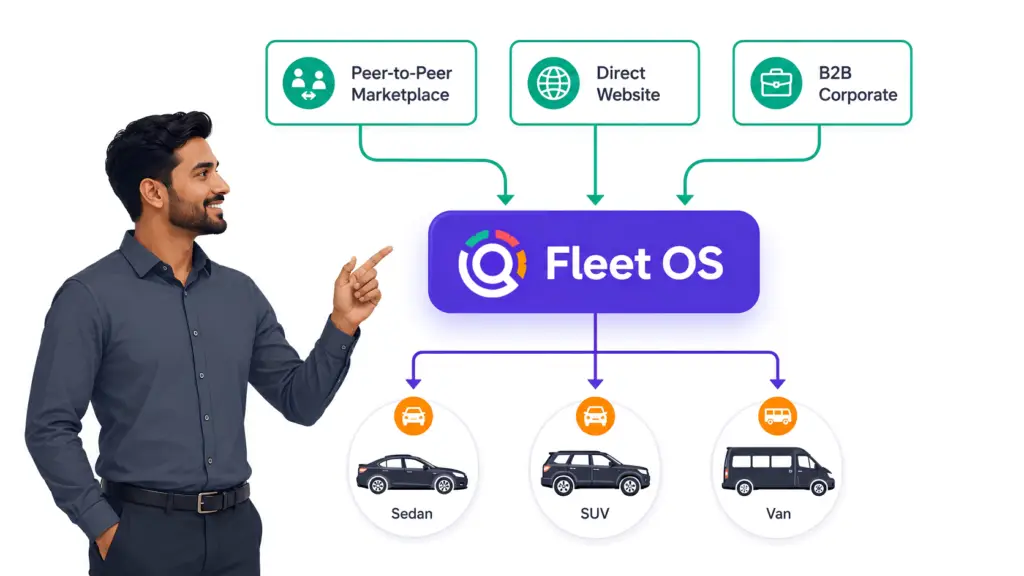
Qarhami is a fleet operating system for Turo hosts and rental operators, with its own hardware: Qarhami Track (hardwired) and Qarhami OBD (plug-in).
For compliance specifically, two things matter.
It can be the permitted device where the market allows that class. Track is a hardwired aftermarket device; OBD is a plug-in. Neither is a substitute where a rule names an OEM, TAG, KYCS or Thatcham-certified system, or requires non-OBD connection. In those markets, run the mandated system and decide separately whether you want an operating layer alongside it for trip context and daily workflow.
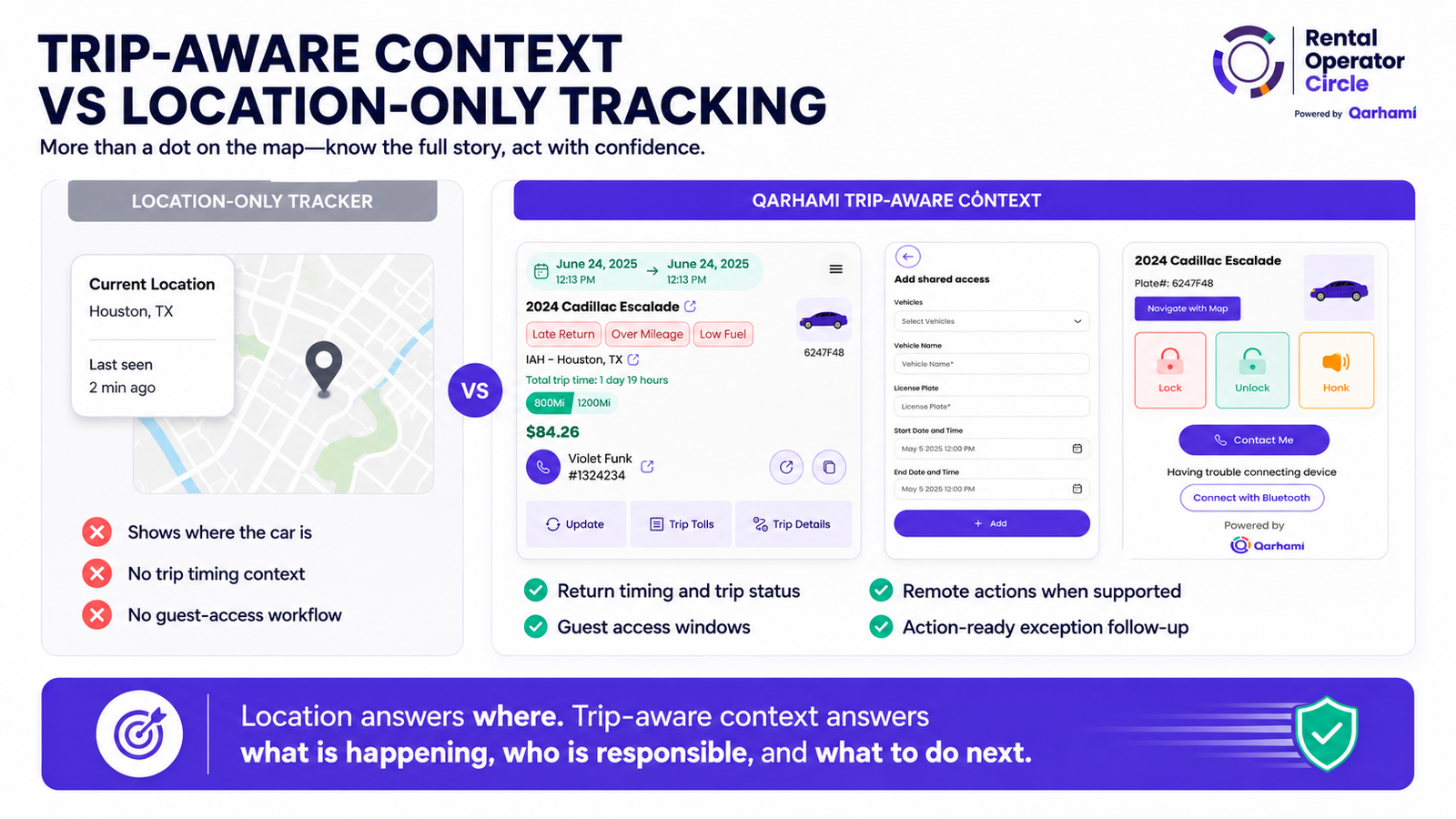
It gives you somewhere to keep the evidence. Vehicle records, trip history, tracking timelines, geofences, shared access and maintenance history sit against the car — which is where install proof, subscription status and access reviews need to live if they’re going to survive a claim.
Guest access is built around a bounded window rather than handing over a credential: one vehicle, a start and end time, with lock, unlock and locate.
A built-in Bluetooth guest-access capability will be available in late October so when the cellular connectivity doesn’t reach an underground ariport parking lot, guests can still connect to the vehicle, this Bluetooth update will have retrofit path for eligible existing devices.
Qarhami does not make you compliant. It gives you a place to prove you are.
Many do. Turo permits hosts to use GPS and telematics to protect vehicles, and some high-value cars are required to have an activated tracker of a specified class.
No. Turo permits broad categories, then applies specific rules by country and vehicle value. Check the rule that applies to your car, not a product list.
No. Turo prohibits AirTags as active vehicle trackers, with penalties up to account suspension or removal. Other consumer mesh tags are not a workaround.
Only with disclosure and explicit written consent in Turo messaging before activation — including OEM cameras and aftermarket dashcams with an interior view. No consent means the feature stays off.
No. Several markets name a device class: activated OEM in the US above $125,000, TAG or KYCS in Canada, Thatcham S5 or S7 in the UK above £50,000, and non-OBD in Australia above A$75,000. A generic tracker does not substitute.
Turo states it may withhold covered damages — up to 20% above the earnings-plan damage responsibility in the US and Australia, and up to $30,000 in a Canadian theft. Failing to provide requested data may also reduce or void protection.
Write down, for every car you list: its market, its current fair market value, its age, the rule that applies, the device class you’re running, the subscription renewal date, and every account that can see its location.
Most hosts cannot produce that list today. The ones who can are the ones who don’t get surprised by a rule they were always subject to.
If you have Ontario inventory, do it before 4 August 2026.
Keep the evidence somewhere it survives. Start a Qarhami trial and put your vehicle records, install proof and trip history in one place.
Get the next one. Subscribe to Rental Operator Circle for operating systems, fleet controls and growth playbooks built for hosts who run this as a business.